

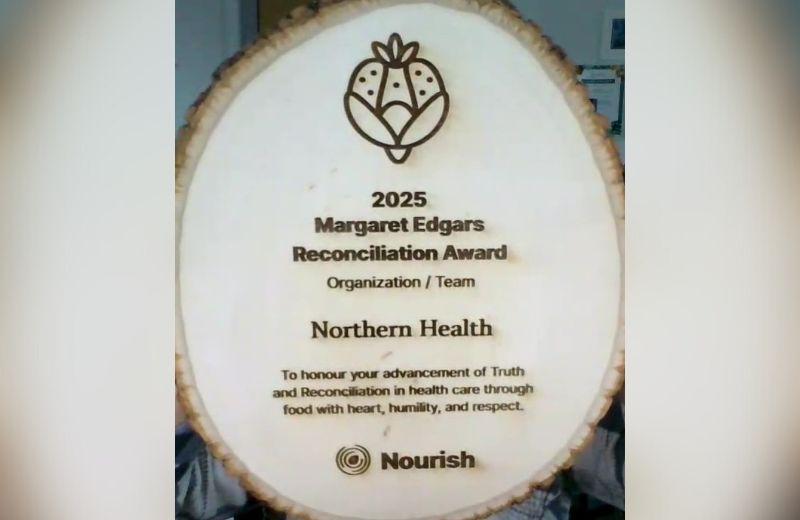
Northern Health (NH) has been honoured with the 2025 Margaret Edgars Reconciliation Award – Organization Award, recognizing efforts to advance Truth and Reconciliation in health care through food with heart, humility, and respect. The award celebrates collaboration between Indigenous and non-Indigenous partners and the work to bring traditional foods into hospitals and care facilities.
This journey began in 2017 when Dieticians Shelly Crack and Tessie Harris partnered with Haida Elders Jenny Cross and Margaret Edgars in the first Nourish cohort. Together, they brought a shared vision: making space for culturally significant foods—like salmon, oolichan, and berries—in health care settings. Margaret, who has since passed away, left a lasting legacy through her words, teachings, and the generosity with which she shared her knowledge. Her guidance continues to shape the work today.
“Margaret taught us that food is love and food is medicine,” reflected Myrna Bell-Wilson, NH Indigenous Health Service Assistant. “Her teachings remind us that reconciliation begins with respect for the land and the foods it provides.”
“Our work was inspired by Margaret,” says Shelly Crack. “She taught us the importance of traditional foods and truth-telling in a loving way, always leading with respect for the land.”
Haida knowledge holders guide the process, ensuring cultural protocols are honored.
“The Haida tell us who should receive the food and how it should be prepared,” Crack explained.
“We as Haida people have sustained ourselves by the abundance of food provided by Haida Gwaii - everything we need is here. The berries, the fish, and the shellfish. When the tide is low, the table is set. These foods are not only nourishment but carry our stories, our teachings, and our identity. Sharing them in health care is a way of bringing our culture into spaces where healing happens,” reflected Bell-Wilson.
For Elders, the impact is profound. “When Elders receive traditional foods, it’s more than a meal; it’s healing,” Crack said. “I’ve seen a 90-year-old light up with joy when tasting foods from their culture. It brings comfort, dignity, and a sense of home.”
Beyond cultural connection, this work supports local food providers and sustainable practices. “Harvesting and preparing foods traditionally strengthens local economies and helps care for the land,” she added.
The journey hasn’t been easy. “It’s a battle working within colonial systems,” Crack admitted. “Food safety policies don’t always align with traditional food systems, but we’ve worked with environmental health officers and knowledge holders to find solutions.”
NH is now embedding traditional food access into policy, including long-term care menus, and plans to grow food at hospitals. Future menus will also feature traditional foods like prawns, crab, halibut, and salmon.
This recognition by Nourish leadership is more than an award; it is a celebration of the leadership of NH Dietitians, who are embedding traditional food access into care with humility and respect. Guided by Margaret Edgars’ vision, and supported by Indigenous voices like Myrna Bell-Wilson, the work continues to show how food can heal, connect, and reconcile.
“When we bring traditional foods into hospitals and care facilities, we are not just feeding people, we are restoring connections to land, culture, and spirit. It is reconciliation in action, and it shows our Elders and families that their ways of knowing are valued here,” said Bell-Wilson.
Together, Indigenous and non-Indigenous partners are building a future where food is medicine, food is love, and food is a bridge to healing.

Comments