

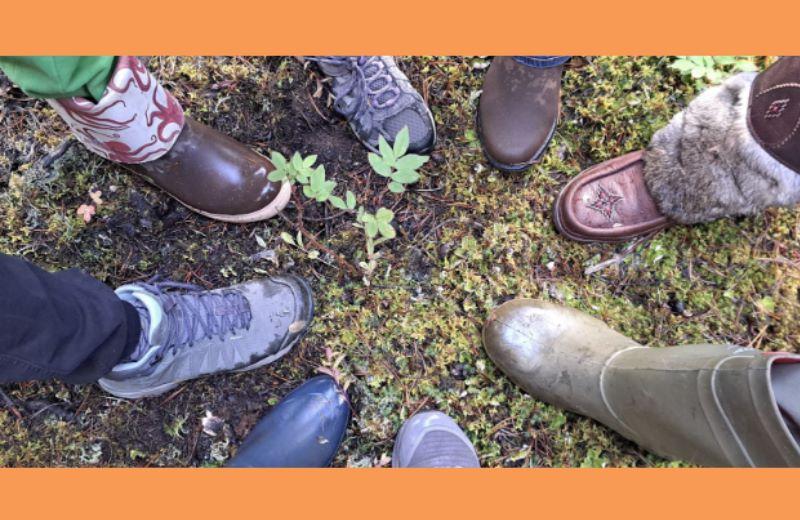
My time as Northern Health's (NH) Interim Climate Change and Health Lead brought so many highlights: Collaborations with climate champions, innovative projects taking root, and the privilege of supporting communities preparing for and responding to environmental change. One initiative stands out: the Planetary Health Learning Garden. It captures what this climate change work is really about. Building resilience isn't just about infrastructure and service delivery; it’s also about people, communities, and our connections to place.
As someone who works remotely on a small, geographically dispersed team, much of my work happened through a screen. The Learning Garden offered something different: A chance to meet colleagues and peers in person, to learn on the land, and to see places like Witset, where the fall session of the training was held. What impacted me most was the ability to shape my own learning journey, focusing on skills directly relevant to my work in climate change and health rather than following a prescribed curriculum.
What is the Planetary Health Learning Garden?
The Planetary Health Learning Garden offers a collaborative training approach that supports learners from across disciplines, sectors, and professional contexts to promote health in a rapidly changing world. The learning is grounded in Indigenous knowledge, cultural safety, and systems thinking. Health professionals play a crucial role in protecting people from climate-related health risks, but they cannot shoulder it alone. This training model promotes the building blocks of health—clean air, safe water, healthy food, and sustainable energy.
The Learning Garden is co-led by Wii Estes Sandra Martin Harris (Witsuwit'en Nation of the Likhsilyu, Little Frog Clan and UNBC PhD Candidate) and Margot Parkes (Professor, UNBC), and supported by founding partners UNBC, the Public Health Association of BC (PHABC), and the Rural Coordinating Centre of BC (RCCbc). It brings together health professionals from across disciplines—nurses, physicians, environmental health officers, scientists, and other practitioners—to strengthen our collective capacity to address complex health challenges while honouring Indigenous wisdom.
Shannon Turner, PHABC's Executive Director, described the vision for the project "The Planetary Health Learning Garden is an opportunity for us to bring the public health workforce into a more holistic way of engaging with our role in the natural world."
Planting seeds: A year-round learning approach
Rather than following a conventional workshop format, the Learning Garden is structured around seasonal rounds. Four distinct learning periods mirror the natural cycles of planting, growing, harvesting, and reflecting.
Sandra Martin Harris described these rounds as "seasonal touch points connecting to an idea of growing, harvesting, and benefiting from what we've planted."
Participants move through a complete cycle over the course of a year, with each season offering a different kind of engagement.
As I wrote this in winter, we were in a reflective season, the time for synthesis and contemplation before the cycle begins again.
What the seasonal approach looks like:
- Spring: Explore new topics in planetary health (e.g., air quality and respiratory health, food systems and nutrition, mental health and nature connection).
- Summer: Apply learnings in your daily work.
- Fall: Gather to share experiences, reflect on solutions and challenges.
- Winter: Synthesize insights, share knowledge, and integrate.
This rhythm creates space for deeper integration than a single training session could provide, allowing participants to learn, practice, reflect, and grow over time. The initiative's approach is beautifully captured in a visual poster that illustrates how Indigenous leadership and planetary health workforce development interweave through the seasonal cycle.
Margot Parkes explained a core intention of the training. "Creating an opportunity for participants to understand Indigenous health issues from a perspective that reconnects Indigenous health with the health of the land. That is a core tenet of the training."
"Land-based learning and healing, why the land, water, our animal relatives and plant kin are so important to our wellbeing—they are essential for our futures," added Harris.
The connection between our environment and our health
In Northern BC, the connections between environment and health aren't abstract; they're part of daily reality. Wildfire smoke drives up respiratory admissions. Extreme heat affects our Elders. Climate-related evacuations create lasting mental health impacts. At the same time, time spent outdoors can reduce stress. Traditional food harvesting strengthens nutrition and cultural continuity. Access to safe drinking water, affordable foods, and places to connect fundamentally shapes our wellness.
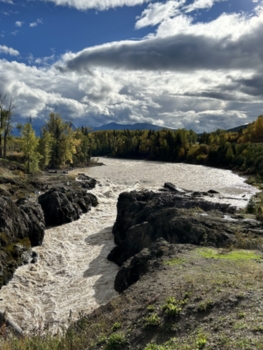
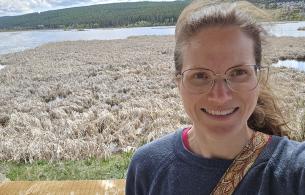
During our Fall gathering in Witset, I witnessed these connections firsthand. As an Environmental Health Officer by training, I found myself reflecting on the Wetzin Kwah (aka Bulkley River)—unseasonably warm and swollen for that time of year—and the mountains with glaciers sitting noticeably low. These weren't just observations, they were signals about drinking water safety, fish populations, wildfire risk, and the traditional foods and wildlife that depend on these systems. The connections between environmental change and health weren't theoretical. They were right in front of us. These connections between health and place are foundational to resilience and understanding them is essential to the work we do.
The Learning Garden creates space for health professionals to deepen this understanding. As Parkes noted, "This is a way to help people gain perspective and think of the environment and health in relation to care instead of fear.”
Turner added: "By embracing land-based learning and Indigenous ways of knowing and being, we find a means to strengthen the emotional and mental well-being of a workforce challenged by a growing number of wicked problems and often disconnected from the earth of which we are essentially a part of."
Seeds taking root: Looking ahead
NH has been a partner in this first round of Planetary Health Learning Garden training. The curriculum supports alignment with Action 5 of NH’s Climate Change and Sustainability Roadmap: o integrate sustainability and climate change education and outreach for staff and build the skills needed into their work.
For me, the Learning Garden planted seeds that continue to grow. Even as my role at NH has shifted, I'm carrying this work forward. I'm taking a course from the Seed Library and embarking on further studies. I find myself returning to the relationships I built over the past year and the training's core idea. Building resilience means nurturing our relationships with place, with Indigenous knowledge, and with the land itself.
As health professionals across Northern BC (and beyond) engage with initiatives like this, we're building not just knowledge, but a deeper understanding and personal resilience needed to support our communities through environmental change. The work continues, season by season, as these seeds take root and grow.
More information
- Northern Health Climate Change and Sustainability Roadmap
- BC Ministry of Health: Climate Change and Health in British Columbia – From Risk to Resilience
- Public Health Association of BC
- Planetary Health Learning Garden
- Towards a Planetary Health Learning Garden: Visual Representation
Interviews with Dr. Margot Parkes and Sandra Martin Harris were conducted by Tomos Land during his internship with Northern Health's Population and Public Health Observatory, funded by the Pacific Institute for Climate Solutions.




Comments