

Since its establishment three years ago, the Northern BC Climate Action Network (NorthCAN) has championed a cross-sectoral approach to climate solutions in Northern BC, with over 400 people from a range of diverse fields participating in the NorthCAN community.
Northern Health (NH) is part of the drive for further climate cooperation in the region because climate change impacts both the health and wellness of northerners, and the health system itself. Northern Health’s Strategic Plan commits to, “partner[ing] with staff, medical staff, communities and organizations, and researchers to build a climate-resilient health system.”
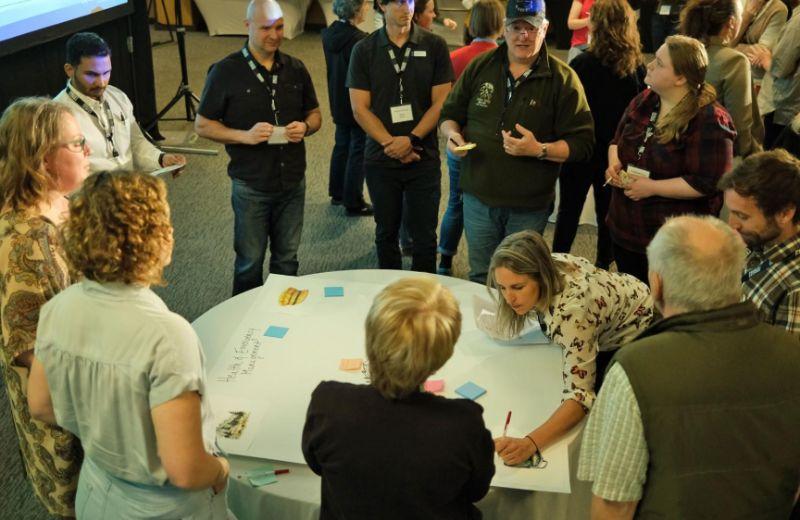
Earlier this year, members of NH’s Population and Public Health team hosted a collaborative session at the NorthCAN Forum event in Prince George. The event focused on supporting health and wellness in Northern BC communities in the face of climate change.
To dig deeper into NorthCAN’s objectives, we spoke with Rob van Adrichem, Director of External Relations for the Community Energy Association, who helped establish NorthCAN and currently facilitates the network.
Why is climate collaboration important?
For van Adrichem, bringing together multiple sectors is fundamental to responding to climate change in Northern B.C. The network includes people who work on “identifying, developing, implementing and influencing climate action and low-carbon initiatives in local communities,” van Adrichem said, with regards to both the public and private sector.
The active participation of individuals from communities and various public and private sector organizations illustrates how climate change can’t simply be addressed by any single organization in the North.
As a result, van Adrichem noted, “the only way to build our capacity is to do things collaboratively.”
“There is a holistic understanding of the importance of jobs and the economy, as well as the sustainability of communities in our region, and this is a strong feature of our region,” he continued. “The way this relates to business as well as to the land and the environment and by extension services such as education and health care is also front and center.”
Enthusiasm for sharing information and building relationships across the region is what, “really influences this network. We realize that this is what’s necessary to be able to develop and mobilize the capacity to implement solutions that bring multiple benefits to communities,” said van Adrichem.
Where does Northern Health fit in?
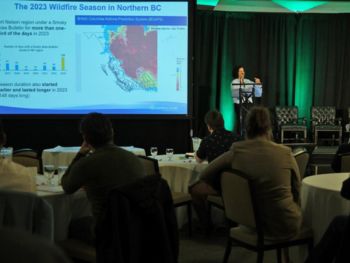
Having led sessions at the recent NorthCAN forum, NH and health care staff play an important role within the network. As one of the most recognizable and respected institutions in the region, van Adrichem believes NH brings significant legitimacy and capacity to the group.
“The participation of Northern Health over the last couple of years, has been really welcomed by people in the network because of the strong opportunity to bring together education, health, industry, local governments, and First Nations around some common ideals,“ said van Adrichem.
“After the heat dome [in 2021], there was an increased understanding of the fact that climate change is happening now and is not some issue to be dealt with in the future,” said van Adrichem. “The same goes for the increase in wildfires over the last decade. Climate change as a health issue has become much more tangible, and as a result Northern Health’s role in dealing with it has become more apparent.
This growing awareness has led to changing perceptions of the risks and solutions to climate change, says van Adrichem. He believes that a problem that was once “talked about purely from a technological perspective and from the standpoint of technical solutions” is now being viewed “much more holistically, intertwined with everything we understand about health and community resiliency.”
What does the future hold for NorthCAN?

Looking ahead for the network, van Adrichem envisions continued cooperation between organizations and sectors, and above all wants to see a change in the climate discourse in Northern BC.
“I think the relationships that are forming between people in different sectors and between communities are creating a level of confidence and awareness of what’s happening in the region that make NorthCAN participants feel they’re not alone, he said. “More communities and organizations are speaking with confidence about climate leadership in Northern BC. I'm already seeing this – people are excited when their projects are featured at NorthCAN meetings. There’s real pride when Northern communities are recognized for their leadership.”
“As northerners, we know what it feels like to be left behind, but there’s a spotlight on our region now. Climate and energy security are such important global topics now, and the communities in this region have so many ingredients needed to lead the low-carbon transition,” he added. “This could be transformative, but we have to figure out how to unleash the amazing leadership potential of Northern BC. It’s an exciting challenge.”
And what about Northern Health?
In November 2025, NH launched its Climate and Sustainability Roadmap, which articulates goals and actions for the organization over the next five years. Many of these actions will happen in partnership with communities, organizations, researchers, and partners across the North.
What’s next for 2026?
NH will chair an upcoming NorthCAN meeting in early 2026, building on learnings and feedback from the NorthCAN Forum held earlier this year.
This will be an opportunity to share more about NH’s Climate Change and Sustainability Roadmap – particularly the actions and next steps for implementation and how they support planning and priorities in communities.
We look forward to building on the connections made at NorthCAN to support healthier communities and create a more climate-resilient health system across Northern BC.








Comments